Showing posts with label divx. Show all posts

Channel 4 - The Fake Trade (2008)

Official Website

There are lots of people who don't care if the goods they buy are original or knock-offs, as long as they look like the real thing and they're cheap. After all, what harm can there be in buying a fake designer bag or trainers - all you're doing is denting the profits of the multinational manufacturers. But, as the first of this two-part investigation shows, it goes much deeper than that. For instance, with the counterfeit market now encompassing pharmaceutical drugs, consumers could be damaging themselves, too. Among the more eye-opening revelations is a massive seven-storey shopping mall in China selling nothing but fakes, and a peek into a backstreet factory that manufactures eggs out of industrial chemicals because it's cheaper than keeping real chickens.

Two-part series examining the global industry of fake goods and how luxury brands and large companies are struggling to fight back. The hidden victims of counterfeiting are slaves forced to work in factories, relatives of people who have died after taking fake medicines, and investors and regulators who face death after leading the battle against illegal goods syndicates. The programme also looks at how the internet has led to a rise in the number of fake medicines detected across Britain.

Download:

Part 1:


Part 2:

The Great Wall of China (2007)

It was the most ambitious building project ever attempted in the history of mankind. And its story has been almost impossible to tell - until now. Based on astonishing new archaeological finds and extraordinary first-person accounts, Great Wall of China tells the story of one of the greatest wonders the world has ever known.

It's more than 3,000 miles in length and was built in just 20 years by a workforce of nearly two million using technology and construction techniques that continue to inspire awe even today. The story of its building, one of human drama, labour and loss, is told in this film through three individuals, each one central to the tale. Thirteen-year-old Emperor Muzong, whose Kingdom is pushed to the brink of destruction by invading Mongolian warriors, demands that a wall be built that can never be breached again. General Qi Jiguang, a military hero and engineering genius, is tasked with overseeing the largest workforce ever assembled on earth. And Zhou Li, an ordinary soldier, is forced to work in conditions of unimaginable hardship but ultimately finds sanctuary and peace in the shadow of this great wall.

Download:

EYESTEELFILM & National Film Board of Canada - Up the Yangtze (2008)

Official Website

A luxury cruise boat motors up the Yangtze, navigating the mythic waterway known in China simply as "The River." In the biggest engineering endeavour since the Great Wall, China has set out to harness the Yangtze with the world's largest mega-dam. Meanwhile at the river's edge Yu Shui says goodbye to her family and turns to face the future. From their small patch of land, her parents watch the young woman walk away, her belongings clutched in a plastic shopping bag. The waters are rising.

The Three Gorges Dam, gargantuan and hotly contested symbol of the Chinese economic miracle, provides the epic and unsettling backdrop for Up the Yangtze, a dramatic and disquieting feature documentary on life inside the 21st century Chinese dream. Stunningly photographed and beautifully composed, Up the Yangtze juxtaposes the poignant and sharply observed details of Yu Shui's story against the monumental and ominous forces at work all around her.


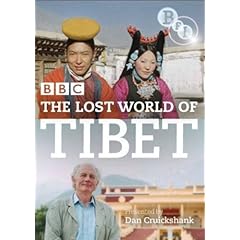
BBC - The Lost World of Tibet (2008)

This film is being brought to television as a result of a BBC/British Film Institute co-production. A recently restored treasure-trove of colour films from the 1940s and 1950s provides the core of this astonishing film, which allows us to see what Tibet was like before its brutal occupation by China. As members of the aristocracy and the Tibetan government in exile recall, the Tibetans world revolved around a series of colourful religious festivals, taking up 68 days of the year. In The Great Prayer Festival, monks take over from the government for a few days and, whilst ceremoniously whipping their subjects, impose fines for such offences as singing in public or having a dirty house. The film includes a revealing interview with the Dalai Lama, who reminisces about how much he missed his mother and his envy for his brother who got to play with all his toys.

Channel 4 - Dispatches: Undercover in Tibet (2008)

Official Website

A timely report on life in Tibet under Chinese occupation as Tash Despa returns to his homeland after eleven years in exile, accompanied by award-winning director Jezza Neumann. For three months the pair risked imprisonment and deportation as they tried to uncover the true extent of the so-called 'cultural genocide' described by the Dalai Lama. Their film reveals that the nomadic existence of native Tibetans is being eradicated and that freedom of expression is increasingly tightly policed.

Download:

BBC - A Year in Tibet (2008)

Unaccompanied by Chinese authorities for the first time, BBC cameras offer an insight into the daily lives of Tibetans and reveal the significance of Buddhism within society.

Download:

BBC Newsnight - A Great Leap Forward? (2008)

China's economy is, by any measure, a success story. Eleven per cent economic growth, rising wealth even among the poor and it's all set to be showcased spectacularly at the Olympics. Amid the celebrations, it's hardly been acknowledged that this is the 50th anniversary of the Great Leap Forward - Chairman Mao's failed attempt to modernise China the first time round. In Paul Mason's powerful presentation on China he asks what few in that country's media are prepared to: What are the parallels between then and now? We'll also be getting Lord Patten's analysis of how China is faring economically. Fifty years on from Mao's Great Leap Forward, BBC Newsnight's Paul Mason finds a country haunted by fears of a financial bubble, environmental disaster and struggling to come terms with the political injustices of half a century ago.

Download:

Nat Geo - China's Driving Dreams

Cars are racing into China, supercharging its economy and delivering dreams of a better life. But cars are now clogging highways and spewing out clouds of pollution. The rest of the world better watch out, because some Chinese automakers have plans to flood the global market with cheaper models. In the Geely Automotive plant in Ningbo, a worker shares some alone time with his girlfriend in the canteen after hours before heading back to the dormitory he shares with seven other men. The company's chairman and founder, Li Shufu, welcomes the freshmen at his university in Beijing, who one day will work at Geely and take its products global. David and Vivian Ren shop for a car in Beijing, before spending a 12-hour day picking it up, arranging the licence plate and paying for it all with cash. The automobile industry and private car ownership are pivotal to China's economic advancement. Call it a driving dream or a nightmare, this is China's revolution on wheels.

Download:

BBC 4 - Why Democracy? - Please vote for me (2007)

Official Website

Chinese Director Weijun Chen's charming film takes us into the world of Chinese schoolchildren, learning about democracy for the first time as they try to vote for their class monitor.

Elections are pretty uncommon in China, so when the children in a school in Wuhan, Central China are presented with the chance to choose their own class monitor they don't quite know what to make of it. It doesn't take them long to get into the swing of it, though, and soon all sorts of dirty tricks are going on. Urged on by their parents, the candidates launch elaborate campaigns of bribery and coercion.

After tantrums and tears, it's finally time for the vote, and who will win - the sweet girl who woos her voters with her flute playing, the bully who beats his classmates, or the boy who has the best sweets.

Download:

Download from Rapidshare:

CBC - China's Sexual Revolution (2007)

Official Website

You've heard about China's Cultural Revolution and its sizzling Economic Revolution. But you haven't heard about its other great social upheaval - the Chinese Sexual Revolution - and like everything in that country it's happening at warp speed.

It's China's version of the 60s revolution - on steroids.

China's Sexual Revolution is the world's first glimpse - often using secret cameras - into this forbidden new China. It's a surprising portrait of the Chinese today: the new free love generation that's left their parents in shock; the booming sex industry that's creating an HIV crisis; the new generation of career women and feminists that suddenly wants it all - while millions of men feel left out.

Download:

Five - The Great Escape: China's Long March

Documentary about one of the most epic military expeditions ever. Surrounded by hostile armies, Mao Zedong's 87,000-strong Communist Red Army escaped and traveled nearly 6,000 miles on foot, in just one year. Their suffering was huge, and their casualties immense, but in an extraordinary feat of endurance, and despite repeated attacks, they preserved and re-established themselves as a fighting force. For the first time, the survivors tell their incredible stories.

Download:

Channel 4 - Unreported World: China's Olympic Lie (2007)

Official Website

When it won the Olympic bid, China promised to improve its human rights record. Instead, as this week's Unreported World reveals, things have got worse. In a world exclusive, Reporter Aidan Hartley and Producer Andrew Carter film inside one of Beijing's 'black jails' - which the authorities deny exist - and with ordinary people suffering the consequences of fighting eviction to make way for Olympic infrastructure.

China has spent £19 billion on the Olympic sites, but this figure represents a fraction of the money that has gone into one of the swiftest and most radical urban redevelopment schemes in all of human history. Some 5,000 old neighbourhoods, or hutongs, have been bulldozed to make way for avenues of high rises and up to 1.5 million people have been forcibly relocated. Although many are happy to receive compensation and relocation to new apartments, the eviction packages are not negotiable and many who refuse to move have suffered terrible consequences.

Everywhere the team travels in Beijing they meet desperate and angry ordinary Chinese, many of them elderly, who have been beaten, threatened and intimidated by developers and government officials who warn: 'The sooner you leave the more you win, the longer you leave it the worse you will suffer'.

View Online:

Download:

China vs the US - The Battle For Oil

China's sky-rocketing growth and shortage of sufficient resources is forcing China to set its sights outside its borders in a frantic search for oil, but the major oil-producing countries are kept off-limits by the United States, forcing China to do business with the rogue states, African dictatorships, Iran and former Russian states - to get the oil they desperately need. Featuring field encounters, archival footage, news reports and maps to outline the latest threat in world geopolitics.

Download:

China's African Takeover

Toiling for survival in the mines of Africa, even children are forced to work here. And behind this boom, the Chinese. China needs Africa's Copper and Cobalt to feed its fast growing economy. The Chinese bring work and money, but it all comes at a tragic human cost.


Download:

Channel Five - Mao's Bloody Revolution Revealed (2007)

Documentary offering a portrait of Mao Tse-Tung, one of the 20th century's most controversial leaders. Author and former BBC correspondent Philip Short looks at Mao's life from his childhood and rise to power to his death in 1976. The programme examines the legacy of Mao's rule of China and features exclusive interviews with some of Mao's inner circle, as well as dramatic unseen footage from the period of the cultural revolution.

Download:

PBS - Frontline - The Tank Man (2006)

Official Website

The spring of 1989 saw the largest pro-democracy demonstration in the history of China's communist regime. The following timeline tracks how the protests began in April among university students in Beijing, spread across the nation, and ended on June 4 with a final deadly assault by an estimated force of 300,000 soldiers from People's Liberation Army (PLA). Throughout these weeks, China's top leaders were deeply divided over how to handle the unrest, with one faction advocating peaceful negotiation and another demanding a crackdown. Excerpts from their statements, drawn from The Tiananmen Papers, reveal these internal divisions.

Watch Online:


Tibet: Cry of the Snow Lion

Official Website

Ten years in the making, this award-winning feature-length documentary was filmed during nine journeys throughout Tibet, India and Nepal. Cry of the Snow Lion brings audiences to the long-forbidden "rooftop of the world" with an unprecedented richness of imagery... from rarely-seen rituals in remote monasteries, to horse races with Khamba warriors; from brothels and slums in the holy city of Lhasa, to magnificent Himalayan peaks still traveled by nomadic yak caravans. The dark secrets of Tibet's recent past are powerfully chronicled through personal stories and interviews, and a collection of undercover and archival images never before assembled in one film. A definitive exploration of a legendary subject, Cry of the Snow Lion is an epic story of courage and compassion.

CBC - The Blue Buddha: Lost Secrets of Tibetan Medicine

Official Website

Twelve hundred years ago the people of Tibet developed a comprehensive medical system. They understood how the mind affects the body. They knew subtle ways of changing the body's chemistry with medicines made from plants and minerals. They blessed their medicines in lengthy rituals. And they encoded this knowledge in a series of elaborate paintings called thangkas.

Blue Buddha: Lost Secrets of Tibetan Medicine traces the odyssey of traditional Tibetan medicine from it's roots in ancient Tibet, to a worldwide interest in it's traditional medical wisdom. We meet several leading physicians in India, as the program introduces us to the basic concepts of this ancient system of healing. We also trace the fate of the 77 thangkas that comprise the Atlas of Tibetan Medicine, the great mnemonic device that encodes the entire system of healing. From the snows of Siberia and the Himalayas to the vital culture of Tibet in exile, in Dharamsala, India, this is a stunning high-definition look at where Tibetan medicine has come from.

Download:

The Yogis of Tibet (2003)

This documentary film follows the lives and practices of Yogis in Tibet, people who have spent their lives in rigorous and secret training in order to gain the ability to exert control over their bodies and minds. Living exceptionally isolated lives, Yogis have been relatively unstudied by outsiders in the past.

History Channel - Declassified: Chairman Mao (2006)

Mao was the 20th Century's answer to Napoleon: a brilliant tactician, a political and economic theorist, and a statesman who ruled a billion people for three decades. In death, he has become divine, worshiped as a god in a godless country. Considering who and what he ruled, Mao, with his Little Red Book, might just be the single most powerful human being who ever lived. We mine formerly guarded vaults and archives to reveal untold stories in a relentless search for the truth behind the legend.