The Blood of Yingzhou District (2006)

The Blood of Yingzhou District chronicles the lives of several orphans: and also documents the efforts of Chinese and foreign relief workers to help the children, even though the challenge appears overwhelming.
The Blood of Yingzhou District chronicles the lives of several orphans: and also documents the efforts of Chinese and foreign relief workers to help the children, even though the challenge appears overwhelming.

Watch Online:
 Official Website
A timely report on life in Tibet under Chinese occupation as Tash Despa returns to his homeland after eleven years in exile, accompanied by award-winning director Jezza Neumann. For three months the pair risked imprisonment and deportation as they tried to uncover the true extent of the so-called 'cultural genocide' described by the Dalai Lama. Their film reveals that the nomadic existence of native Tibetans is being eradicated and that freedom of expression is increasingly tightly policed.
Download:

Download:

Download:
 Angry workers in China are defying government orders and taking to the streets to protest about mass redundancies and corruption.
Watch Online:
 Santa's Workshop takes you to the real world of China's toy factories. Workers tell us about long working hours, low wages, and dangerous work places. Those who protest or try to organize trade unions risk imprisonment. Low labour costs attract more and more companies to China. Today more than 75% of our toys are made in China. But this industry takes its toll on the workers and on the environment.
The European (and American) buyers blame bad conditions on the Chinese suppliers. But they say that increasingly hard competition gives them no option. Who should we believe? And what can you do to bring about a fairer and more humane toy trade?
Watch Online:
 Cars are racing into China, supercharging its economy and delivering dreams of a better life. But cars are now clogging highways and spewing out clouds of pollution. The rest of the world better watch out, because some Chinese automakers have plans to flood the global market with cheaper models. In the Geely Automotive plant in Ningbo, a worker shares some alone time with his girlfriend in the canteen after hours before heading back to the dormitory he shares with seven other men. The company's chairman and founder, Li Shufu, welcomes the freshmen at his university in Beijing, who one day will work at Geely and take its products global. David and Vivian Ren shop for a car in Beijing, before spending a 12-hour day picking it up, arranging the licence plate and paying for it all with cash. The automobile industry and private car ownership are pivotal to China's economic advancement. Call it a driving dream or a nightmare, this is China's revolution on wheels.
Download:
 We examine the rising tensions between Taiwan and China.
Watch Online:

Following in the footsteps of many American companies, dot com companies have invaded commerce in China. They're now fully competitive with Western net stocks. But with hundreds of new websites cropping up every month and the number of websurfers doubling every 6 months, the pressure's on the government to find a way to regulate the internet. Jack Ma is the creator of Alibaba.com, a global on-line marketPlace for small and medium businesses. He's eager to stake his claim in the capital available for fledgeling internet companies. The feasibility of this for Jack lies in the decisions the government makes for regulation of these start-ups. The Chinese government has already blocked some sites, such as those having to do with Tibet. Some are seen as borderline, like the site which helps gay men cope with coming out. They must be very careful not to bend the strict government-imposed rules, or they too will be blocked. As China gets more entrenched in the Capitalist world, we can't help but wonder how long the government will be able to maintain a vice grip on the media.
Watch Online:

Pirate CDs of Western music have come flooding in. The kids can’t get enough of it but authorities remain unimpressed. 500 soldiers from the People’s Liberation Army were sent to keep watch over the country’s first ever outdoor rock concert in the Yunnan province. The local vice-mayor, Zhang Hongping views the new fashion with suspicion: “When young people hear this kind of very stimulating music they often lose their reason,” However, no matter how hard it tries, the Chinese government will struggle to quell the new tide of rock music that is breaking in China.
Watch Online:

Watch Online:

Sun Hong Yuan was literally trapped in the wheels of production. “The machine was out of control,” he recalls. “It fell down and crushed me.” Disabled and useless to his employers, he was soon fired. With his future plans in ruin, his one hope is that lawyer Zhou Litai will take on his case and help him win compensation. Zhou Litai has dealt with over a thousand similar cases. He’s become a hero to the working classes by taking on the bosses who run unsafe factories or refuse to pay their workers. “Some entrepreneurs simply seek economic profit,” he explains. “They neglect the protection of workers.” But in a society where challenging the system is highly dangerous, he knows he’s pushing his luck. Officials in a neighbouring city were even planning to run him out of town before media attention gave him a measure of protection. “He’s trying to lure the authorities into addressing this very important issue,” explains NGO worker Nicolas Becquelin. And thanks to his efforts, workers in China are discovering rights they never knew they had.
Watch Online:

In 1993, the East bank of the Pudong river was little more than a giant paddy field. Today it’s full of sprawling foreign managed factories and skyscrapers. The scale of construction has been immense - 2 years ago it was said that Shanghai had one quarter of the world’s construction cranes. This rapid rejuvenation is attracting Chinese from all over the Nation: “The Shanghainese live a very busy life, but they think that Shanghai is the best Place to live in the world,” comments Mary Gu, one of Shanghai’s new arrivals. However, in the rush to build, much of Old Shanghai is being flattened. Anxious residents flock to see the urban planning centre model, hoping to find their own few millimetres still intact. Madam Chen is one of those who has already been displaced. She is finding it hard to survive without the rent from her house: “They told us if they tore down 4 houses, they would give me 4 rooms back. Now my life is hard and difficult. I don’t care how much better Shanghai becomes.” Shanghai may be able to impress international investors, but the benefits offered by the government may take some time to filter down to the losers in their game plan.
Watch Online:

Watch Online:

China’s modern Communist Party bears little resemblance to the one which rose to power under Chairman Mao. Its new heroes are the very figures he used to fight. Factory owner Zhang Yue is one of the richest men in China. He was a teacher when the government began encouraging workers to start their own businesses. Now, 10 years on, his business empire has an annual turnover of $200 million. Recently, the Communist Party has even been encouraging entrepreneurs like Zhang Yue to become party members: “We see the private entrepreneur as one of the builders of the country’s socialism.” Embracing capitalism with open arms, the Party still insists it is red to the core. But others beg to differ. Dai Qing grew up in a revolutionary family. She believes the heroes of the Long March would be shocked by what the Party has become: “There is no Communist Party at all. Right now, we only have a corrupt party.” The gap between rich and poor is widening. Corruption is rife and popular discontent is growing. Will the Communist Party’s new “re-vamped” image be enough to save it from extinction?
Watch Online:

In a Beijing hospital, a women is undergoing an operation. After sawing her leg bones in two, surgeons start drilling holes through her calves. They then hammer in long, metal pins. The aim is not to correct any illness or deformity, but rather to stretch the woman’s legs by 8 cm, thereby making her taller and more attractive. These days, the dull conformity of socialist dogma has all but disappeared, to be replaced by a kaleidoscope of Western-style consumerism. It’s a world where appearance is becoming all-important, where many will go to painful extremes to become something they’re not. It’s a time of breathtaking change in the world’s most populous country. But for China’s women, it seems they have merely exchanged one set of shackles for another.
Watch Online:

China claims thousands of Uighurs have received training in Afghanistan and have links to Osama Bin Laden. It’s detained thousands of Uighurs since September 11th and torture is allegedly widespread. Muslim clerics have been sent in droves for ‘re-education’. Amnesty International claims “the current campaign is essentially a campaign against dissent and opposition”. But Xinjiang’s Communist party secretary retorts “Amnesty International is prejudiced.” He also makes clear “There’s no room for negotiation. China is a unified country”. Separatist bombings and riots have rocked Xinjiang since the 1980’s, but there have been no serious attacks since 1997 - although Uighur separatists were linked to the recent death of a senior Chinese diplomat in neighbouring Kyrgyzstan. It seems the ‘war on terror’ is a pretext for a war on freedom… On the first official media visit to the province in two years, the filmmakers are prevented from talking to ordinary Uighurs, trailed and filmed at every turn, shown a ‘model mosque’ and a ‘model village’. But under the cover of darkness, brave individuals speak out: “Work all day and starve. That’s why people stir up trouble… they all want independence, but don’t have the power to achieve it”. A massive influx of Han Chinese to work on a 4,000km gas pipeline has fuelled Uighur unemployment and done more to fuel resentment than any foreign fanatics.
Watch Online:
More than a decade after the fall of the former Soviet Union and Eastern European communist regimes, the international communist movement has been spurned worldwide. The demise of the Chinese Communist Party is only a matter of time.
ChinaDocs Warning: Please be aware that while this is an interesting documentary, it is made by, and therefore biased towards, the Falun Gong movement. Its neutrality is questionable.
Part 1: On What the Communist Party Is ?
Watch Online [ Hi ]
Download [ Hi ]
Part 2: On the Beginnings of the Chinese Communist Party
Watch Online [ Hi ]
Download [ Hi ]
Part 3: On the Tyranny of the Chinese Communist Party
Watch Online [ Hi ]
Download [ Hi ]
Part 4: On How the Communist Party Is an Anti-Universe Force
Watch Online [ Hi ]
Download [ Hi ]
Part 5: On the Collusion of Jiang Zemin with the CCP to Persecute Falun Gong
Watch Online [ Hi ]
Download [ Hi ]
Part 6: On How the Chinese Communist Party Destroyed Traditional Culture
Watch Online [ Hi ]
Download [ Hi ]
Part 7: On the Chinese Communist Party’s History of Killing
Watch Online [ Hi ]
Download [ Hi ]
Part 8: On How the Chinese Communist Party Is an Evil Cult
Watch Online [ Hi ]
Download [ Hi ]
Part 9: On the Unscrupulous Nature of the Chinese Communist Party
Watch Online [ Hi ]
Download [ Hi ]
 China's Lahu minority has for centuries lived in the Yunnan hills bordering Burma. The hills have kept the Lahu safe and secluded but also poor and malnourished. Now forty-six ten-year old Lahu girls are sent to an elite Chinese primary school where they will learn to speak Chinese and enter mainstream Chinese society. Can the girls do well at the school yet maintain their cultural identity?
Watch Online:
 We follow labor researcher Zhang Yaozu as he visits laid-off workers in northeast China, once the nation's industrial hub and now due to the privatization of state-owned enterprises called China's Rust Belt.
Watch Online:
 The Lao Gai are the largest gulags of our times, providing the slave labour helping to propel China's economy. Rare images smuggled out reveal the brutal conditions inside the camps.
Watch Online:
 In the past six years, infant birth defects in China have increased by an unprecedented 40%. This rise is being blamed on pollution from factories. Now green campaigners are taking on the multinationals.
"The untreated waste is pumped out secretly at night", states activist Wu Deng Ming, pointing at a water outlet leading from a factory into a river. "People living along the river have enlarged livers", claims one local. They suffer from: "loss of appetite or cancer and all sorts of terminal diseases". Although strong laws governing pollution exist, these are regularly flouted. "Some local officials give protection to polluters", claims Ma Jun. In an attempt to put pressure on polluters, campaigners are naming and shaming guilty companies online. "We let people know that this company, with such a popular brand, is violated waste water discharge standards". There are also signs that central government is taking the problem more seriously. "The state is very serious about environmental problems", states official Zhou Linbo. Some factories have been closed down. But strong resistance to change still exists. "Polluting factories hire hooligans to deal with people they believe will damage their reputation", claims Wu Deng Ming. Other companies threaten to relocate to Vietnam or Indonesia where; "we can still discharge more of less freely".
Watch Online:
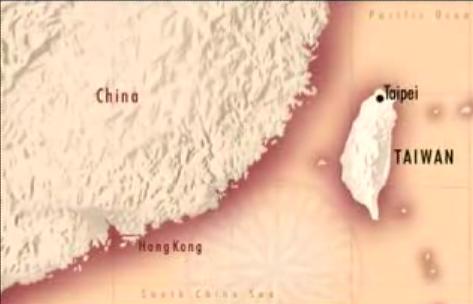 The President of Taiwan's stubborn push for independence has made him China's Public Enemy Number One. But how likely are these tensions to escalate into a military conflict?
"The world cannot sit by idly to see an undemocratic China remove the freedom, democracy and rights of Taiwan's citizens," laments President Chen Shui-Bian. But despite his best efforts, Taiwan's international support is dwindling. Only 25 countries still have diplomatic ties with it. Everyone else recognises mainland China. And since Chen came to power, China has stepped up its rhetoric, making it clear it will attack if it feels Taiwan is moving towards a formal declaration of independence. "As everyone knows, Taiwan is an inseparable part of the Chinese territory," states one Chinese commander. "The task of our military is to defend the motherland and to ensure its territorial integrity." President Chen's problems are further compounded by the deep political divides in Taiwan. Only half the country considers him their legitimate leader. The others believe he is a crook who staged a mysterious shooting the day before the elections, when he was trailing badly, to boost his support. And much as the Taiwanese tend to see themselves as a sovereign country, few want to go to war over it. After all, as one woman says, "Mainland China is so big and we are so small."
Watch Online:
 Official Website
Chinese Director Weijun Chen's charming film takes us into the world of Chinese schoolchildren, learning about democracy for the first time as they try to vote for their class monitor.
Elections are pretty uncommon in China, so when the children in a school in Wuhan, Central China are presented with the chance to choose their own class monitor they don't quite know what to make of it. It doesn't take them long to get into the swing of it, though, and soon all sorts of dirty tricks are going on. Urged on by their parents, the candidates launch elaborate campaigns of bribery and coercion.
After tantrums and tears, it's finally time for the vote, and who will win - the sweet girl who woos her voters with her flute playing, the bully who beats his classmates, or the boy who has the best sweets.
Download:


